


Stabilizing rents and growing tenant activity signal market rebound as vacancy rates drop and sublease space shrinks.
By J.C. Casillas, Managing Director, NAI Capital Commercial Research
MARKET OVERVIEW
The Inland Empire office market is showing signs of recovery, with broad-based tenant demand driving increased occupancy levels. Landlords are responding proactively to this resurgence by stabilizing asking rents, benefiting from a more positive market environment. This uptick in tenant activity is gradually reducing the surplus of unoccupied office space, fostering optimism for continued improvement.
In Q2 2024, total vacant office space, including sublease space, decreased by 103,466 square feet year-over-year, indicating that the market may be emerging from its low point. Vacant sublease space alone saw a modest 1.3% dip compared to the previous year.
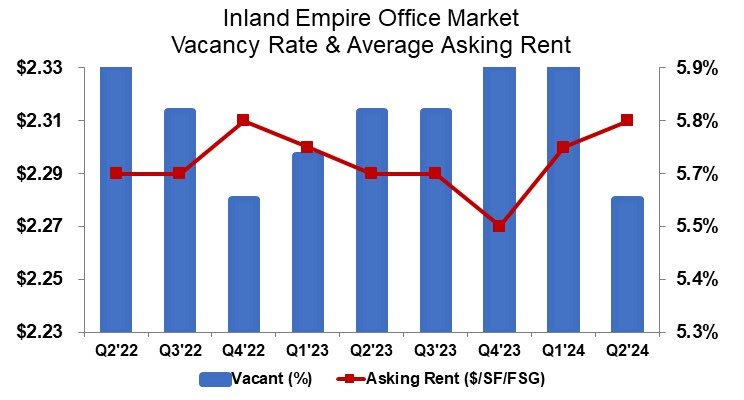
Throughout the first half of 2024, vacancy rates have gradually declined, with the overall rate dropping by 20 basis points year-over-year to 5.6%. The stabilization of vacant office space has been supported by evolving remote work trends and changes in space utilization strategies. Direct vacant office space has decreased by 755,000 square feet since its peak during the pandemic, while occupied office space has grown, now exceeding pre-pandemic levels by approximately 1.4 million square feet.

A significant reduction in vacant sublease space—down 54.3% from pre-pandemic levels (about 75,000 square feet)—mirrors the office market’s recovery trajectory, reminiscent of the post-Great Recession period around 2013. This notable absorption of vacant sublease space has contributed to relatively stable asking rents, which now stand at $2.31 per square foot on a full-service gross basis—up 1 cent quarter-over-quarter and 2 cents higher than a year ago. Leasing volume has also shown resilience, with a 12.6% increase quarter-over-quarter, despite a 9.2% decline in year-to-date leasing activity compared to the same period last year.
TRENDS TO WATCH
Tenants seeking value in buildings with vacant sublease space will find limited opportunities. In the first half of 2024, tenants subleased 12,509 square feet in the Inland Empire, representing a 15.8% decrease compared to the same period in 2023. The trend of offloading excess space through subleasing has lessened, with a steep drop of 38.0% in vacant sublease space offerings quarter-over-quarter. This decrease is particularly notable in the Airport submarket, which saw a 65.6% reduction in vacant sublease space, compared to just 12.4% in the West market. As subletting activity becomes more competitive, the average asking rent for sublease space in Q2 was $2.23/SF, offering only a 3.5% discount compared to direct space. With less vacant sublease space on the market, sublessors may be less motivated to lower rents, as much of the space hasn’t been available for extended periods.
Employment sectors that drive office space demand have experienced growth. According to June figures from the State of California Employment Development Department, key sectors, including Professional and Business Services, have seen positive gains despite an increase in the Inland Empire’s unemployment rate compared to a year ago. Over the past 12 months, Professional and Business Services—a key office-occupying sector—added 2,100 jobs. This growth signals a stabilizing factor for office occupancy, which is crucial for sustaining demand.
Additionally, the average cap rate for office properties decreased by 60 basis points in Q2 from mid-year 2023, reaching 6.0%. This drop in cap rates contributed to a notable 31.0% year-over-year increase in the average price per building square foot sold, which rose to $245/SF. However, sales volume for the first half of the year fell by 2.3% to $155.4 million, with the average size of buildings sold decreasing by 5.3% to 12,198 square feet. This trend is expected to continue into the second half of the year as the office market moves through its trough.


